
CCL Prep Time: There Is No Single Answer — It Depends on Your English Level
The most common question from CCL candidates is: "How long do I need to prepare?" The honest answer is that it depends almost entirely on your current English proficiency. Candidates with near-native English can be exam-ready in 2–4 weeks. Candidates with lower proficiency may need 8 weeks or more.
This guide breaks down realistic preparation timelines by English level, explains the examiner luck factor most candidates overlook, and gives you a clear priority order for your study material.
CCL Prep Time by English Proficiency Level
Strong English (PTE Academic 75+ / IELTS 6.5–7.0 equivalent): 2–4 Weeks
If your English grammar is near-perfect and you can follow fast, natural speech without effort, you are already meeting half of what the CCL demands. At this level, the exam is almost entirely a test of LOTE (Language Other Than English) interpreting skill — not English ability.
What you need in 2–4 weeks:
- Master the CCL segment format and consecutive interpreting technique
- Build LOTE vocabulary for exam topics: healthcare, legal matters, immigration, housing, social services
- Complete a high volume of scored practice dialogues to get your LOTE output fluent and accurate
- Practise strict time management from day one (see the 2026 time limit section below)
If your English listening is smooth and your grammar holds up under pressure, 2–4 weeks of focused daily practice is a realistic exam-ready timeline. Don't add extra weeks just because you feel uncertain — time spent practising beats time spent waiting.
Intermediate English (PTE 65–75 range): Minimum 4 Weeks of Intensive Study
At this level, English proficiency itself will cost you marks. Language quality deductions accumulate when grammar is shaky, register is inconsistent, or phrasing sounds unnatural. You can't fix this by practising LOTE harder — the English side needs work too.
What changes at this level:
- Minimum 4 weeks of intensive daily practice — not 4 weeks of casual review
- Active work on English register: read formal service-context texts in English (health information sheets, government letters, legal notices) to absorb the language patterns the exam uses
- Extra attention on interpreting from LOTE → English: this direction is where intermediate English speakers lose the most language quality marks
- Scored practice that specifically flags language quality deductions — you need feedback on output, not just accuracy
Four weeks is a minimum, not a guarantee. If your scores are not trending toward 65/90 or above in the first two weeks, extend your timeline before booking the exam.
Lower English Proficiency: ~8 Weeks (4 Weeks Structured + 4 Weeks Solo Practice)
If your English is significantly below the IELTS 6.5 threshold, you need to build grammar fundamentals before focusing on interpreting technique. Attempting interpreting practice before your English foundation is solid means practising errors into muscle memory — which is harder to fix than starting from scratch.
The recommended approach:
- Weeks 1–4: Structured learning — a tutor, a CCL preparation class, or a structured self-study program that explicitly targets English grammar, register, and the vocabulary domains the exam covers. Build the foundation first.
- Weeks 5–8: Solo practice — high-volume scored dialogue practice using what you've built. At this point you have the foundation; now you build interpreting fluency on top of it.
Trying to compress 8 weeks into 4 at this level is the most common cause of first-attempt failures. The exam fee is AUD $800+. It costs less to prepare properly than to sit twice.
The Examiner Luck Factor: Train Above the Pass Mark
There is a variable in CCL outcomes that most prep guides don't mention: examiner strictness varies significantly.
The CCL is marked by human examiners. While NAATI provides marking guidelines, interpretation of borderline responses is subjective. Some examiners are stricter on register inconsistency. Others weight accuracy omissions more heavily. This is not a flaw in the system — it is an inherent feature of human assessment of a complex skill.
The practical implication: do not train to the minimum pass mark. If you are consistently scoring 64–66/90 in practice, a strict examiner can push you below 63. If you are consistently scoring 72+/90, examiner variation is far less likely to cost you a pass.
Train to a higher standard than you think you need. The extra margin is insurance against examiner variation, a bad dialogue topic, or an off day. Read more about how the CCL 90-point scoring system works to understand exactly what examiners are measuring.
Study Priority: Volume of Practice With Exam-Style Format
The most consistent predictor of CCL success is simple: how much realistic practice you do before exam day. Candidates who complete a high volume of exam-style dialogues — covering the topics and format of the real test — consistently outperform those who study theory or practice casually.
What "realistic practice" means:
- Dialogues that match the real exam topics: healthcare, legal matters, immigration, housing, social services, education
- Consecutive interpreting format — listen to a segment, then interpret it out loud, in full, without pausing or replaying
- Scored feedback after each session so you know which of the three dimensions (accuracy, language quality, delivery) you are losing marks on
- Timed sessions that reflect the real exam's approximately 20-minute window
Reading about interpreting technique is not a substitute for doing it. Every session of active, out-loud practice builds the skill that the exam actually tests. Passive study — reading transcripts, watching videos — does not.
The 2026 Time Constraint: Strict Time Management From Day One
Starting in 2026, the CCL exam has a total time limit of approximately 20 minutes. This is a critical change that affects how you need to prepare.
What it means in practice: if you exceed the time limit, your remaining responses go unscored. Unscored responses count as zero. A candidate who runs out of time on even two or three segments can drop from a passing score to a failing one — regardless of how well they handled the earlier segments.
The implication for preparation is direct: practise strict time management from your very first practice session. Do not get comfortable with pausing, replaying, or taking extended time between segments. Train under real time pressure from the beginning so that pacing is automatic by exam day.
Specifically:
- Use a timer during every practice session
- Never pause or replay audio — train with a single pass, as in the real exam
- Practice resetting quickly between segments; don't let thinking time bleed into the next segment's listening window
- Complete full mock exams under timed conditions in the final two weeks of preparation
See our full 8-week CCL preparation plan for how to build timed practice into each phase of your study schedule.
How to Choose the Right Timeline for You
Use this as a starting framework:
- Estimate your English level honestly — PTE Academic or IELTS score is the most reliable indicator. If you have not taken either, rate yourself against the descriptions above.
- Add buffer for LOTE gaps — if your LOTE formal vocabulary is weak (you speak the language at home but rarely use it in professional or service contexts), add 1–2 extra weeks to any timeline.
- Book the exam at the end of your timeline — having a fixed date creates urgency. Candidates without exam bookings consistently under-prepare.
- Track your scores weekly — if you are scoring consistently above 68/90 in practice with two weeks to go, you are on track. If you are below 63, extend or rebook.
For a detailed week-by-week structure, read the CCL 8-week preparation plan. For the 12 technique-level strategies that separate passing candidates from those who don't, see how to pass the CCL exam.
Start Practising Today — Free on BuMate
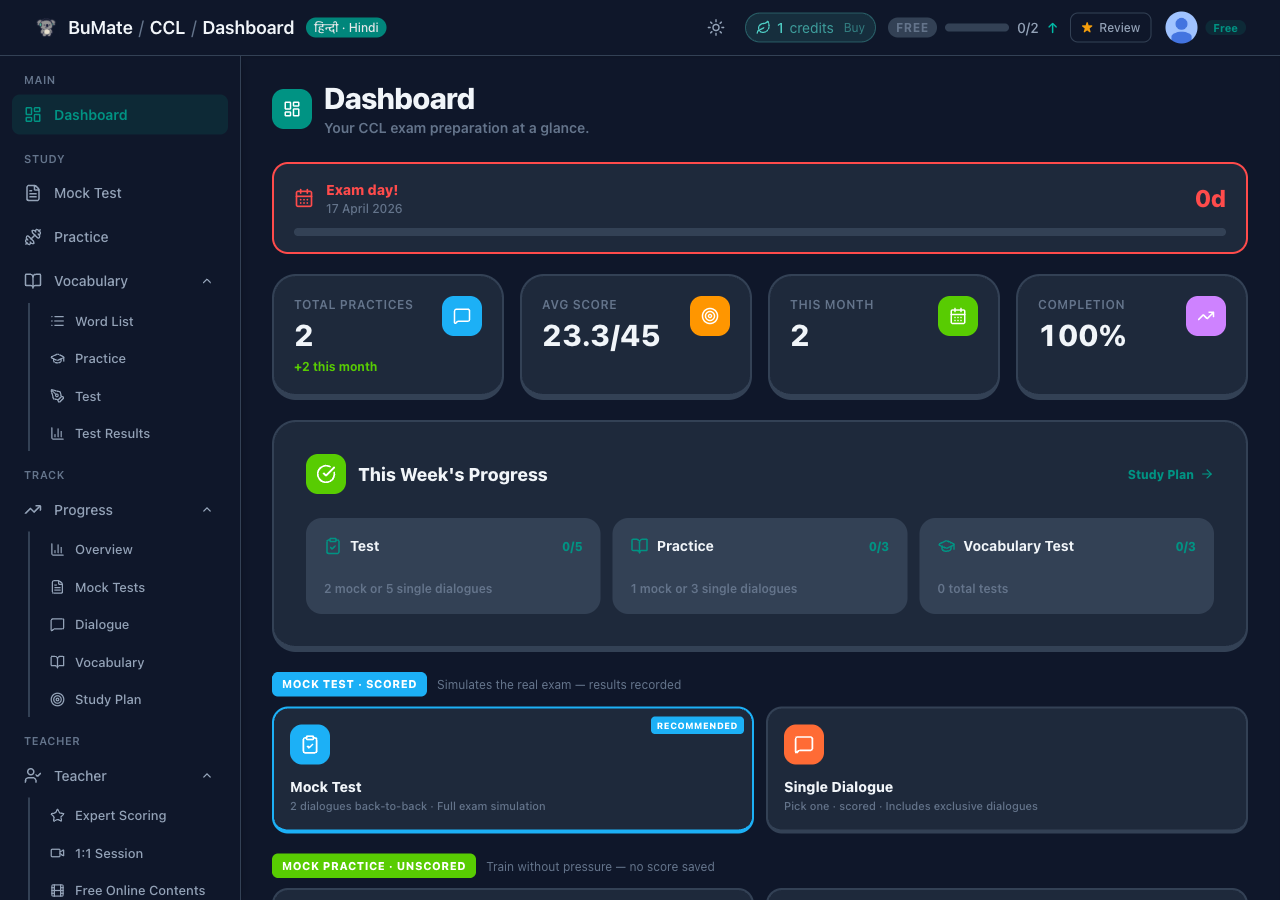
BuMate provides AI-scored CCL practice dialogues with NAATI-aligned feedback across all three scoring dimensions: accuracy, language quality, and interpreting technique. Practise in your LOTE language pair, track your scores over time, and know exactly what to fix before your exam date.